Showing posts with label past. Show all posts

Saturday, April 30, 2016

"The days were sweet, our nights were warm..."

Today's Saturday Song Selection is more than twenty-five years old, but it's new to me; I'd never heard it before March of this year. This one plucks a few of my heartstrings.

I've lived more than half my life within half an hour's driving distance from US Highway 90, both in Texas and Louisiana, though never near the parts of Texas where bluebonnets grow. I especially relate to the lyrics about a wife who stays home while her husband goes away to find work. I've lived through separations like that. Those were hard times. The separations would have been unbearable had we not believed we were sacrificing time together in the name of building a better future.

The song reminds me of what might have been--and what was for a period of years. I never counted on getting used to the months apart. On enjoying the peacefulness of them. On acquiring a taste for solitude. I guess that would be a whole 'nother song.


The song is "Gulf Coast Highway," performed by Emmylou Harris and Willie Nelson. Thanks to toshiboss for posting the video and lyrics on YouTube.

Saturday, February 13, 2016

Tightly Packed

Our assignment for the most recent Life Writing class was GROWING UP IN YOUR FAMILY. As part of that, it was suggested that we characterize the members of our family. I've done that here, to the best of my memory and ability, but I'm curious: I wonder whether this story would be largely the same or quite different if my sister, Judy, had been the one to write it. She's the only one still alive who lived this with me. Well, she and my Uncle Joe, but he skipped out early. 

Speaking of Judy, I mentioned in the story that we "didn't always play well together." That was true, but I can't think of anyone I'd rather "play with" now than Judy. We have an amazing number of common interests now that I've given up paper dolls and she's given up horse pretensions.

Tightly Packed

I shared a double bed with my mother until I was almost fifteen. Our big dresser stood to my right, Mother slept to my left, and my little sister, Judy, slept to Mother’s left in a small bed of her own. Judy shared her youth bed with a collection of dolls and stuffed animals. It’s a wonder any of us had room to turn over.

Ours was one of three upstairs bedrooms in my grandparents’ home in Springfield, Missouri. The room directly across the stairway landing from ours was usually occupied by renters, college students who attended nearby Southwest Missouri State Teachers’ College. A smaller bedroom centered between our room and the students’ belonged to my Uncle Joe, who was only seven years older than I.

Downstairs, my grandparents, Mammaw and Packy, had the bedroom at the front of the house, a corner room where light flooded through sheer curtains on two sides. A narrow hallway ran from their room all the way back to a fifth bedroom, where my great-grandmother, Dora, could wake up in the mornings and look out on the bright colors of Mammaw’s flower garden.

In 1953, when I was ten, we got our first television set. Grandma Dora passed away in October of that year. The following year Joe graduated high school and promptly took off for Mexico with his best friend, not telling anybody where he was until he called and said he’d be back from time to time, but first he wanted to see the world. Mammaw was distraught, and Packy was fit to be tied. I don’t recall what Mother and Judy had to say about the situation. As for my own reaction, I kind of enjoyed the sudden expansion of elbow room. I thought I might get a room to myself, but I didn’t.

Things gradually returned to normal. Judy and I went to school, Mother and Packy went to work, and Mammaw stayed home to keep the household running. She had the hardest job of all. She climbed upstairs to clean the college boys’ room and downstairs to do the laundry in the basement. She did it all while wearing clunky, two-inch high heels, nylon stockings rolled to her knees, and a fresh, clean apron over a crisply starched housedress, usually one she’d made herself. She hummed as she did her housework. Her smiles were warm and plentiful, and she never complained. When Mammaw rested, she read: Good Housekeeping, Redbook and several other magazines she liked. She also liked flowers, soap operas, and everyone she ever met.

Packy, a World War I veteran, was pleasant but stoic. He didn’t talk much, but he did dispense a little discipline by calling Judy or me to come back and shut the screen door properly every time we’d run through and let it slam. Packy wore khaki shirts and khaki pants with suspenders to his job at the furniture store and didn’t change out of them until bath time, whether he’d spent the evening working in his big vegetable garden or watching TV. Mammaw kept a thick Indian blanket over the sofa to protect it from both garden soil and from the tobacco that spilled from the white, drawstring pouch of Bull Durham Packy kept in his shirt pocket. Each time he rolled a cigarette, a few specks of tobacco fell to the floor. He claimed tobacco was good for the carpet, kept the worms out of it. Packy was a reader, too, but his tastes ran to the daily newspaper, the Reader’s Digest (which he kept in the bathroom), and paperback murder mysteries. He was an avid fan of the St. Louis Cardinals and President Harry Truman.

Mother was moody. She could be tons of fun, but when I run a reel of “Young Mother” images through my mind, I see more frowns than smiles. She was beautiful and stylish, especially when she dressed up for work or to go out for an evening. She was a skilled seamstress and made a lot of her own clothes, including a coral-colored, poodle-cloth coat and matching tote bag once. She sewed many of our clothes, too. She contributed income to the household but otherwise didn’t help out much at home. She ironed the clothing that she, Judy and I wore each week, washed the supper dishes once in a blue moon, and supervised Judy and me in the cleaning of our bedroom. Even though she didn’t have many regular chores, she wasn’t afraid to tackle larger projects. I recall holding on to her legs as she sat on an upstairs window sill and leaned backwards into the open air to wash our bedroom windows, and I remember another time she redecorated our room, modernizing it by painting the woodwork white, covering the old floral wallpaper with a shade of paint called Dusty Rose, and adding a rose-patterned border where the walls met the ceiling.

Like her parents, Mother enjoyed reading. She bought murder mysteries and movie magazines at the newsstand near her job. Packy read the mysteries when Mother was finished, and I read all the movie magazines, even one I knew she didn’t want me to read. It was called Confidential  and was a precursor to today’s gossipy tabloids. I specifically remember one story in Confidential about Robert Mitchum, the actor. The magazine reported that Mitchum attended a Hollywood party and, after realizing he was the only person there not wearing a costume, downed a few cocktails, went to the kitchen, stripped down to his birthday suit, doused himself with ketchup, then returned to the assembled guests and introduced himself as a hamburger.

With Mammaw and Packy as backup caretakers and little or no assistance from our father, Mother did a good job of providing for Judy and me. Despite holding down a full-time job, she showed up for every important school event. She entertained us frequently, taking us to the swimming pool, the roller rink, the movies, or just to the corner drugstore for ice cream sodas. Still, I never felt I had enough time with her. When she went out for the evening on a date or with a friend, I missed her. Especially at bedtime. Sleep didn’t come easily when her side of the bed was empty. My child’s mind interpreted her absence once or twice a week as rejection. Now I understand how lonely she must have been.

Judy and I didn’t always play well together. We were four years apart in age and didn’t have many common interests. Judy was active and energetic and liked to play outdoors with friends. My favorite pastimes were quiet, mostly solitary ones: reading or drawing clothes (I called it “designing fashions”) for my paper dolls. On summer days I’d sit on the front porch swing in the shade and peek over the top of my Nancy Drew or Ginny Gordon mystery to watch Judy and her best friend, Cindy. They’d pull their hair back into ponytails and pretend they were wild horses. I could see how much fun they were having, racing around the yard, sweating, whinnying and slapping their thighs to make hoof noises, but I was too lazy for their kind of fun.

We got along better after supper. When the heat of the day dissipated, the children in our neighborhood spilled outdoors from houses up and down the street and congregated on sidewalks and in front yards--usually ours, because we were centrally located. There weren’t many of us kids, probably seven or eight at most. We caught lightning bugs together and put them in jars, or we divided into teams and played games like Simon Says and Lemonade (“Show me something if you’re not afraid!”). Hide and seek was never more fun than when shadows fell between the houses and the tall trees. We felt safe in the near darkness because parents and grandparents sat on front porches, chatting, sipping iced tea, watching over us. We knew to stay within shouting distance of our parents and to be back home when the streetlights came on.

When it was too dark or too cold to stay outside after supper, our family would gather in the living room and watch television. Most of us multitasked, a habit carried over from earlier days when we’d gathered there to listen to the radio. Mammaw would sit in the wooden rocking chair, one eye on the TV set, the other on her crochet or embroidery work. Mother sat in the easy chair, pincurling her hair or filing and polishing her nails. Judy and I staked out separate spaces on the rug, she with a favorite toy, I with paper dolls, drawing paper, crayons and scissors. Packy stretched out on his back on the couch. He’d lie flat like that until Judy’s inevitable nightly request: “Packy, make a hole.” Then he’d roll onto his side and draw up his legs to place the soles of his sock-covered feet squarely against the back of the couch so Judy could climb up and snuggle into the space behind his knees.

One day didn’t differ much from the next back then; our routines were familiar and comfortable. Saturday night suppers were always hamburgers, pork and beans, potato chips and soft drinks (known to Missourians as “pop”). The only part of the Saturday menu that ever varied was the flavor of the pop. Mammaw would ask each of us early in the week what we wanted:  Dr. Pepper, Grapette, Orange Crush or something else. Once she’d added all of our requests to her grocery list, she’d call in an order to the Monroe Street Market, and they’d deliver it the next day.

Sunday’s menu was always the same, too: fried chicken after church. Mammaw made sure we all went to Sunday School every week--all of us but Packy, who never did go that I remember. Technically, Mother didn’t go either. She was on the premises every week, but she stayed in the nursery, tending the babies. I always thought she volunteered for nursery duty so she wouldn’t have to listen to the lesson or the preaching. Mammaw always stayed for church after Sunday School, but the rest of us skipped church sometimes. When we did go, I enjoyed the music more than anything. Our Baptist church had a big choir and a huge pipe organ. The hymns I heard on Sunday mornings filled my heart and touched my soul more deeply than any words our preacher, Dr. Eastham, ever spoke. Young as I was, I disagreed with him about some things. I didn’t for a minute believe God was as mean as Dr. Eastham made Him out to be.

Time passes and things change. Rivers run dry, ships sink, familiar family routines come to an end. The summer before I turned fifteen, Judy and I moved to Texas with Mother and her brand-new husband, whom she’d met only three weeks earlier. We left behind Mammaw and Packy, the house and the neighborhood we loved, and Judy’s youth bed. Most of Judy’s dolls went missing, too. I suspect they were left behind intentionally due to lack of space in the U-Haul trailer, though Mother never did admit it. I left my first steady boyfriend, and, more significant over the long term, my sense of security. The memories, though--the wonderful, wonderful memories--those I kept. All those Missouri days and nights were packed in my head and heart so carefully and lovingly that I can take them out and enjoy them even now.

And I do, nearly every day.

Saturday, February 21, 2015

"...And always remember, the dark clouds pass with time"

On days when I walked the six blocks home from Phelps Elementary School alone, I sometimes sang out loud to pass the time. My favorite songs were hits from the radio, and in fourth grade (1951), one ballad dominated my repertoire:


When I think of this song, what I hear in my head is Johnny Ray's voice, but what I see in the visual part of my mind is a tree-lined sidewalk on which a skinny, blond-haired, nine-year-old girl swings a plaid, plastic book bag, paces each saddle-oxford-clad footstep to the beat of her inner music, and belts out the lyrics as unselfconsciously as if no one could possibly hear her from behind fluttering curtains and open windows.

It may be a sad song, but those memories are happy, happy ones.

**********

The song is "The Little White Cloud That Cried," performed by Johnny Ray and The Four Lads.
Click here to read the lyrics.
Thanks to MrSherco12 for posting the video on YouTube.

Saturday, January 31, 2015

"And run if you will to the top of the hill..."

I was first introduced to Rod McKuen's music in 1967 by the man who would later become my second (and last and best) husband. On the drive home from our first date, Richard plugged an eight-track tape into his car stereo, and the car filled with the sound of waves splashing on the beach, the gentle, seductive voice of McKuen himself, and the swelling music of the Anita Kerr Orchestra. That tape was The Sea. It made me appreciate Rod McKuen. More than that, it made me appreciate Richard because he could appreciate Rod McKuen.

Poet and songwriter Rod McKuen died on Thursday at the age of 81. So many of his songs provided background music for my life. My favorite of all of them was this one:


The song is "Jean," written by Rod McKuen.
Thanks to bernieb48 for posting the video and lyrics on YouTube.

Saturday, November 08, 2014

"And I have heard all the stories, you know the stories..."

In the fall of 1973, I moved with my husband and daughters to Farmingdale, New York. If I'm remembering correctly, that's the first place we ever lived where cable TV was more prevalent than rooftop antennae, so, like a good neighbor, we signed up for it. HBO was part of the package. On the day the cable was hooked up, I was quite shocked to turn on a movie (Serpico, I believe it was) and hear Al Pacino drop the F-bomb several times in succession right there in our living room. (Hm. Hadn't thought about it, but HBO may be partly responsible for the potty mouth I struggle with daily; I've always blamed it on my old friend Jude.)

My husband didn't like to go out to the movies, mostly because he couldn't smoke in the theater, but he did enjoy watching popular films on TV. The rest of the family did, too. Many nights found us all curled up together on our family-sized, orange crushed-velvet sofa, eyes glued to the latest offerings on HBO.

A few of those movies still stand out in my mind forty years later, mostly because of the feelings they evoked at the time. One that moved me profoundly is Buster and Billie, the story of a popular high-school boy (played by Jan Michael Vincent) who unexpectedly falls in love with the shy, good-hearted town slut, a relationship that eventually leads to harsh consequences for both of them.

Do you remember that movie? If you saw it, I'll bet you do. And I'll bet you still remember the theme song and that hearing even a few notes of it calls up feelings of sweet, sweet love and heartbreaking sadness. Listen and see what you think:


The song is "Billie's Theme" by Hoyt Axton.
Thanks to Skye Moppit for posting the video on YouTube.
Click here to read the lyrics.

Tuesday, October 14, 2014

Slow Drive, Uphill

Learning to drive was a long, slow process for me--and not an easy one after I lost confidence on my very first try. I managed to describe the learning experience succinctly in the three-word title of this post, but putting it on paper for Life Writing Class called for more details and more words:

**********

 I have no recollection of what kind of car we were in that day, but I clearly remember what I saw through the windshield: a narrow, rutted, dirt road stretched out between two fields of tall grass and a bright blue sky that seemed bigger than the one we’d left behind in Missouri. The next image I can picture is my stepfather’s arms, in short shirtsleeves, reaching across me and grabbing the steering wheel as he shouted, “Stop, stop, stop!” I don’t recall what else he might have said. In hindsight I know what I’d have been saying if I’d been in his position, but the man I hadn’t yet started to call Daddy didn’t like cusswords and didn’t use them.

That was my first driving lesson. Last one, too. Mother had remarried weeks earlier and moved my sister and me to Texas. The plan was to get a house in the town of Orange before school started, but until then we were staying in nearby Bridge City, all of us crammed together in my stepfather’s rented garage apartment, where the sweltering August heat rose up into the two rooms plus kitchenette and the ancient window air conditioner chugged for all it was worth but didn’t stand a chance.

I don’t know whose idea it was to teach me to drive. Not mine, I’m pretty sure. Maybe my new daddy thought it would be a bonding experience. I was 14 years old, and in Texas that was old enough to get a learner’s permit. Which I never did get. My main problem--the one that scared the dickens out of Daddy--was a tendency to oversteer. When a bump in that country road had made the steering wheel jerk a fraction of an inch to the left in my hands, I’d held on tightly and steered to the right, way too far it turned out, then tried to correct that with a forceful turn back to the left, then back and forth, back and forth over the ruts, my foot on the gas pedal the whole time. After the hollering and steering-wheel grabbing, I got the car stopped, and the very short driving lesson ended. Daddy got out of the car and started walking around it, so I knew I was supposed to do the same. We traded places and he drove home. By then I knew what I’d done wrong, but I never got another lesson, so I couldn’t prove it. Not that I ever asked for a second chance; I’d scared myself as much as I’d scared Daddy.

All through high school, neighborhood carpools delivered me safely to school and back, but I had to bum rides from friends for after-school events like choir practice and play rehearsals. After graduation, when I got my first job, Mother scouted around and found a neighbor, Mary-something, who worked across the street from my office and was willing to take me to and from work for a dollar a week in gas money.

I never told anybody, but I did drive one time that first year after graduation. I went with a guy named Ted to meet some friends and go swimming (another thing everyone but me seemed to know how to do). Ted and these other people were not kids I’d known from my school in Orange; they were my best friend Jude’s friends from her school, a wilder bunch who’d gone to West Orange High. They smoked and drank beer. I’d tried to smoke but had given it up after two weeks and one pack of Kents, and I thought beer tasted nasty, so I didn’t drink it. Ted apparently liked beer a lot. When it was time to go home at the end of our date, he handed me the car keys. I looked up at him, surprised, and told him I didn’t know how to drive. He said, “There ain’t nothin’ to it,” gave me a minute’s worth of instructions and fell asleep in the shotgun seat. I drove us home.

The next time I drove I was married and living with my new husband, Bill, in Bryan, Texas. Bill had bought a little piece of land that he called “the farm” in Iola, northeast of Bryan. We’d go there sometimes on a weekend day. Two animals had come with the farm, a friendly, pregnant cow named Hoover and a mean Shetland pony called Silly. If the animals needed shelter, they could find it in the wooded area at the rear of the property or else under a rickety, wooden structure that was nothing more than one wall and a roof held up by a couple of posts. I liked the woods better myself. I’d take a book back there, sit on the ground with my back against a tree and read for hours while Bill did whatever he wanted to do. The only time I knew for sure what he did was the day he borrowed a tractor from the farm’s nearest neighbor so he could mow. When we picked up the tractor that morning, Bill said he’d drive it and I could follow him in the car. The route to the farm was a straight shot on a paved road, so the drive was an easy one.

When the mowing was done, we reversed the procedure. Bill pulled the tractor through the gate, turned and parked it beside the road, then told me to go on ahead while he locked up. He said he’d meet me at the neighbor’s in a couple of minutes. I drove our big, bulky Buick (or whatever it was) through the gate, made the tight right turn, and kept my eyes on the road ahead. Once at the neighbor’s, I waited for a long, long time. It was almost dark when Bill got there. He said I’d bumped one of the big tractor tires when I pulled out, bumped it hard enough to nudge it into a slide. I told him truthfully I’d never felt a thing, but he said the tractor was just slipping into the bottom of the ditch when he turned around after locking the gate. He said he’d stood in the road behind me and waved and waved, but I never even looked back.

By the time I drove again, baby Kim had arrived, and the big Buick had been replaced by a Volkswagen, a much smaller car that had its engine in the back. Kim was asleep and Bill wished he was, so when I mentioned that we were almost out of baby formula, he said he thought it would be good practice if I went the few short blocks to the store by myself while he stayed with the baby. I drove there tentatively and had no trouble until I’d bought what we needed and started for home. Still in the parking lot, barely moving at all, I gently eased the car backward right into a concrete pillar. A close inspection showed not even one tiny scratch on the car and too many scratches on the pillar for anybody to pick out one specific one that I’d caused. On the way home I decided there was no need to mention what had happened. It must have been a week later when Bill asked me if I’d hit something with the car. I confessed immediately and asked, “How in the world did you know that?” He said he’d tried to check the oil but couldn’t raise the hood because the bumper was pushed in about two inches.

After our second daughter, Kelli, was born and my days got busier, it soon became clear that I needed to stop relying on other people for transportation, so I drove a lot more often. I steered mostly with my left hand so I could fling my right arm across the two tiny girls bouncing around on the bench seat next to me and protect them from sudden stops and bumps. Somewhere in that time period I got a driver’s license, but I don’t remember doing it.

When Kim was five and Kelli was three, Bill and I divorced. I was working then, driving every day in a little yellow Corvair Monza convertible, shifting its four-speed transmission with ease, carrying those little girls around with a measure of confidence that didn’t accurately reflect how much I still needed to learn about driving. All I can say is we were lucky.

Then came Richard. He was my second husband, and he cared enough to pay attention to a lot of things, including how I drove. He gave me driving tips, not in a lesson, but one at a time over the course of several years. Once, when he realized that I leaned slightly forward while I drove, he figured out that I was keeping a close eye on the forty- or fifty-some-odd feet of road directly in front of the car. He explained that I needed to focus farther away, far enough down the road that I could spot a hazard before I was right up on top of it. That one change made driving a lot less scary. Another time he noticed how carefully I watched the edge of the road and the centerline to make sure I stayed between them. He suggested that I stop worrying about the edges and line myself up over the dark, oily swath that runs down the center of each lane. He said as long as my wheels straddled the greasy strip, I’d be fine. I‘d always been careful to slow down on a curve, but Richard told me I’d have better traction if I’d slow down ahead of the curve, then accelerate slightly as I went into it. He was right, and I’ve done it his way ever since. One night I asked him about the blue light that mysteriously showed up on my dashboard from time to time. I felt silly, but also quite pleased, when he told me the blue light meant that my bright lights were on. Up until then the only way I could ever be certain about the brights was to test out the headlights on a dark road or the side of a building. I’m just guessing, but the blue-light incident might have been one of the times Richard hugged me close, chuckled in my ear, and called me his “dumb blonde.” He could get away with that once in a while, because I knew that he knew I wasn’t actually dumb. Or blonde.

I’ve driven many miles between then and now, on cross-country family moves, dozens of job-related trips between Baton Rouge and Houston, daily commutes to and from work in heavy traffic. These days I don’t drive a lot. Daytime traffic is hellish, and night blindness shakes my confidence after the sun goes down. Also, I don’t know whether it’s a consequence of aging, long-term trust issues or the fact that so many people can’t seem to put their dad-gummed cell phones down for even a minute, but something has happened in recent years that makes me question the skills and good sense of every other driver on the road.

Even so, there are still times when I’m driving along and it occurs to me out of the blue how much I’m enjoying it. When that happens, when it’s a clear, sunny day and I’ve started out early and I’m on a pretty, tree-lined road where there isn’t much traffic, I get the feeling that I’d like to just keep on driving, keep on going and going until I end up someplace new and different, someplace where I can see new scenery, new faces, and have a little adventure of one kind or another. I think about how freeing it would feel to be that spontaneous. I think about how it would be such a gratifying experience that it probably wouldn’t take more than a day or two before I’d be full of it, ready to turn around and head back home to what’s familiar, what I love. I think how someday I’m going to do that, just drive away and follow the road wherever it leads me. Someday. But not that day.

Thursday, October 09, 2014

Toads Among the Princes

Our last Life Writing assignment was to make a list of all our old boyfriends and say a little something about each of them. I'd done that several sessions ago when the writing topic was "love," so I flipped the topic on its side and wrote this:

**********

Some people say you have to kiss a lot of toads before you find your handsome prince. I say it’s just too much trouble to figure out the difference between them. My first husband didn't seem at all like a toad until I married him, then all I heard for the next six years was "Ribbit! Ribbit!"

Richard, my second husband, was a prince of a man, albeit a prince with a wandering soul. Seven times in twelve years my daughters and I followed him on his quest to expIore what was over yonder hill. When we got to Small Town, Louisiana, I said, “Enough, already!” and he promised we‘d stay. Two years later he left for California. He tried to lure us there with tales of constant sunshine and a remarkable absence of mosquitos, but we chose to stay behind.

That’s how I ended up alone and princeless in the land of the good ol’ boys, where the average guy drives a pickup truck with a shotgun mounted in the rear window and would rather die than be caught reading a book. To be truthful, I have met some above-average men over the past thirty years, even a few princes, but never that special one whose hopes, dreams and lifestyle matched up with mine.

Now that I’m retired, I don’t go out much, preferring the comfort of my own modest castle. Unless an elderly gentleman who likes assertive fat women shows up on my doorstep, my chances of falling in love again are slim. And even if I were surrounded by eager, eligible suitors, it’s exhausting just to think about the amount of time and effort it would take to distinguish a prince from a toad. A toad like these I once knew:


Toad No. 1 - Let’s call him Jake (rhymes with flake):

I’d known Jake years earlier. We’d been neighbors when Richard and I still lived in Texas, and I’d liked him a lot. When he called me one day out of the blue, said he’d been divorced for a while, would be in Baton Rouge the following weekend and would love to see me, I was thrilled. I’d always admired Jake’s calm, cool demeanor and looked forward to a pleasant reunion. And it was pleasant--for an hour or so. We talked as he drove through LSU football traffic. I learned that he was not only divorced from his first wife, who’d been my friend, but from two other women he’d married in the 16 years since I’d last seen him. The third wife had been the widow of a co-worker and good friend who’d been killed on the job. Jake had married her, he said, because his dead friend’s spirit had inhabited his body shortly after the funeral and compelled him to take care of the widow and her children. The widow had left Jake after a couple of years, but I wondered if the invasive spirit might still be around. Perhaps it was he who was driving aggressively, short-cutting through corner gas stations, driving over curbs, cutting people off right and left, swearing loudly and making rude gestures out the window. That sure wasn’t the Jake I’d known before.

Toad No. 2 - Let's call him Herbert (rhymes with pervert):

My good friend Jean and I were just starting dinner in a Baton Rouge restaurant when Herbert walked over, introduced himself, pulled out a chair and sat down at our table. I thought at first that Jean knew him; she thought I did. His dark hair, black-rimmed eyeglasses reminded me of Clark Kent. He was mild-mannered, too, pleasant enough that we didn’t ask him to leave. Over our protests, he insisted on picking up our dinner tab. Jean and I talked afterwards about how weird that was, but we agreed that he seemed harmless.

The three of us had discussed our jobs during dinner, and a day or so later Herbert looked up my work number and called to invite me out dancing. I loved to dance, so I ignored the little signals my brain was flashing and accepted. Herbert took me to a dimly lit neighborhood bar that was decorated with smoked mirrors and red-flocked wallpaper where most of the patrons were older than we were. A small combo played crooner tunes next to a stamp-sized dance floor. In between dances, Herbert ordered cocktails; I stuck with my usual, Diet Coke. Even before his hands began to wander, I’d decided I didn’t like him at all. I wasn’t sure a fake headache was enough to get me home, so I pulled out the big guns and told him I had a bad case of cramps.

At my doorway he asked if he could come in for a cup of coffee. I told him the truth: I didn’t drink coffee and didn’t keep it in the house. He said, “Well, can I at least come in for a minute and use your bathroom?” I let him in and showed him to the downstairs bathroom. He came out of it bare-chested, his shirt and undershirt draped over his forearm. I told him to get dressed and get out, and he got angry, calling me names, yelling that he hadn’t spent his good money on dinner and drinks for nothing. He made a grab for me, but I ducked out of his reach, snatched up the phone and started dialing. He threw on his shirt as he stormed out the door.

Toad No. 3 - Let's call him Peter (rhymes with cheater):

I didn’t date for about a year after Richard and I split up. Peter was one of the first men I met after that. His shiftwork schedule limited the amount of time we could spend together, but I was in no rush to move things along. Most of our so-called dates were low-key events. Sometimes we’d drive around town and talk for an hour or two, sometimes he’d stop by my house for a short visit after he got off work. I was delighted when he had a whole Saturday free and took me to the Jambalaya Festival in Gonzales. We danced, enjoyed the music, and saw a lot of people either he or I knew. We’d been dating about six weeks when I invited him to escort me to a company dinner. Peter looked nice in his coat and tie, and I was proud to be seen with him. It did pique my curiosity when he walked across the room to get a drink and spent several minutes chatting with my co-worker, Rosie (rhymes with nosy).

I was still in bed when Rosie called early the next morning. “Did you know Peter’s married?” she asked bluntly. I was stunned. I remembered the tiny sneakers I’d seen in his back seat. When I’d asked about them, he said his roommate had borrowed his car the weekend before, that the shoes must belong to his roommate’s kid. Rosie continued: “I’ve known Peter and his wife for years. I asked him last night, ‘Do you know that that’s my boss you’re with?’ and he said, ‘Well, don’t tell her nothin’, and I’ll put in a good word for ya.’”


**********

Note: I had to edit this piece for posting here, losing a couple of funny lines in the process. One never knows who'll get their feathers ruffled if they happen to stumble across themselves in someone else's true story on the internet. Also, there was a Toad No. 4 in the original piece, but I've already told you about that one in an earlier post, so I won't repeat. 

Final thought: I love going to this class and listening to other people's stories. They're all so different, yet there are always common elements, bits that strike a familiar chord and remind one or more of us of another story yet to be written.

Sunday, September 28, 2014

Menses and Other Anatomical Catastrophes

A new session of Life Writing has begun, and I've enrolled for the fifth time. Trying to find a common theme for students at all different writing levels (all women this time around), our teacher asked us to write about our first experience with "the curse"--the biological indication that a girl has become a woman. Here's my story:

______________________________

Two things happened when I was three years old that made me believe life is precarious. One day I saw my ten-year-old uncle, Joe, chase a ball into the street and get hit by a car. Another day, at the grocery store, a Lifesaver got stuck in my windpipe, and I couldn’t breathe for a long moment. Fortunately, both Joe and I survived. When I was older I learned that he’d sustained a concussion in that incident but hadn’t had any other serious injuries. As for my own close call, I was scared and upset but perfectly healthy after the quick-thinking, white-aproned grocer grabbed me up by the ankles and whacked me on the back, propelling the green Lifesaver out of my airway and onto the dark-planked floor. Joe’s accident taught me why Mother had spanked me every time I’d wandered into the street. From my own frightful experience, I learned that most Lifesavers were edible and delicious, but the green ones could kill you.

That’s what small children do. They take their limited experiences, jumble them all together with random bits and pieces of information they’ve heard God-knows-where, and try to fit everything into some kind of framework that makes sense to their fledgling logic.

Like most toddlers, I’d been schooled early on about basic anatomical features--eyes, nose, fingers, toes--and I knew two things about my belly: 1) the food and drink I swallowed (and a penny one time) ended up in there, and 2) people seemed to like to poke the button on the outside of it. Belly, tummy and stomach were synonymous to me; I applied the three terms interchangeably to both the outside and inside of what I now know is my abdomen.

My little sister, Judy, was born 44 days after my fourth birthday. I don’t remember whether or not I knew then that she had been carried in my mother’s belly, but such knowledge might explain why I imagined the human midsection to be a large, hollow vessel. I believed that everything I ate and drank simply sloshed around in the bottom of that big container until I sat on the potty and emptied it. When I learned that an important organ called the heart occupied that same space, I pictured it as a bright red, valentine-shaped object floating untethered in a sludge of chewed bananas, creamed corn and cherry Kool-Aid. That’s when my ill-informed, child’s logic kicked in and my worries began. How big was my heart, anyway? What if I accidentally pooped it out, which was what had happened to the penny?

Those concerns persisted even after I started school. Every time I learned the name of another organ--the more of them I imagined floundering around inside me--the greater I perceived the danger that one of them might pop out of my body and cause me to die. Maybe if I’d ever asked someone if such a thing could happen, I’d have received an answer that ended my anxiety, but I didn’t ask, and no adult I ever overheard speaking in casual conversation about a lung or a kidney bothered to mention that human organs are safely secured.

The fear of losing a vital body part wasn’t all consuming, but it lingered at the back of my mind, where I could take it out and mull it over every so often. By the time I was seven or eight, having never heard of anyone dying from a popped-out organ, nor having ever been warned about it, I concluded it must be an extremely rare occurrence and that children were much more likely to die as a result of running with scissors or playing with matches. I began to relax, lulled into a false sense of security that would blow up in my face a few years later.

One summer night when I was eleven, preparing to take a bath, I peeled off my pastel, day-of-the-week panties and saw a dark red stain. Unsettled, not certain the stain was what it appeared to be, I touched a wad of toilet tissue to myself. All the repressed fear rushed back with the speed and force of a rocket. It was happening, just as I’d always dreaded. Something was terribly wrong with my insides; I would probably die before morning.

Wrapped in a towel, I opened the bathroom door just a crack and called loudly to my mother, who was sitting on the front porch with the rest of the family. By the time she got to the bathroom, I was sobbing. I showed her the evidence of my impending doom, and she rolled her eyes and smiled. What the heck? I couldn’t believe how unconcerned she was; it made me cry even harder. Finally noticing the degree of my distress, Mother patted me on one hunched-up shoulder and began to explain: “Don’t worry,” she said calmly. “This is something that happens to all women when they’re old enough to have a baby.” That concept floored me. As far as I knew, a woman had to be married before she could have a baby, and I wouldn’t be old enough for that until I was at least eighteen. This had to be a big mistake.

Mother went on to tell me that this period-thing would happen every month for many, many, many years. She dug into the cabinet underneath the sink, pulled out the blue box of sanitary napkins and a tangled elastic belt, showed me how to rig everything up, and promised she’d buy me a belt of my own the next day. (As far as I recall, she never said a word that night about the possibility of cramps or the probability of mood swings. That information would be doled out later on a need-to-know basis.)

After a few minutes, Mother left the bathroom, no doubt in a hurry to share the embarrassing news with my grandparents, the same way I’d heard her make a little announcement after I’d tried on my first training bra a few months earlier. I locked the door behind her and considered what to do next. The idea of tainting a tubful of bathwater was disturbing, so I decided on a sponge bath at the sink instead. Tears continued to trickle down my face while I washed away summer’s dust and sweat and pondered the whole overwhelming situation.

My thoughts soon turned to sanitary napkins. I was already familiar with them, having been sent to the corner drugstore numerous times to buy a box of them for Mother, but I’d had no idea what their purpose was. A horrible thought occurred to me. What if some of the neighbors had noticed me carrying those big blue boxes down the street and thought I’d bought them for myself? How embarrassing! Another alarming thought popped into my head. For as long as I could remember, my grandparents had rented an upstairs bedroom to male college students, two roommates at a time, individual students moving in or out as the semesters changed. How many times, I wondered, had one of those boys walked past me while I was playing with my dolls in the living room? How many of them had watched me gently lay my Toni doll on her bed, where her carefully coiffed, brunette head would rest peacefully on the thick, white, gauze-covered Kotex pad that was her pillow?

Now my tears were angry ones. If Mother had only told me sooner about monthly periods, I could have avoided both the public display of personal items and the fright I’d experienced minutes earlier. When I finally mustered the courage to leave the bathroom, Mother must have read the expression on my face and realized I was mad at her. She explained as we went to bed that night that her own first period hadn’t arrived until she was sixteen, so she’d thought she still had plenty of time to fill me in.

Maybe so. But considering all the conversations we should have had--and didn’t--before I grew up, got married and had children of my own, I suspect the real reason was that she just didn’t like to talk about those kinds of things.

Saturday, September 06, 2014

Teen Town, 'Tween Town

A couple of years ago my cousin Karen sent me a manila envelope full of letters I'd written to her between 1955 and 1957. Deep down I'd always known I was a geeky, awkward adolescent, not one of the cool kids, and any shred of doubt I might have had about that was erased when I read those letters nearly sixty years after I wrote them. This one, dated Jan. 15, 1957, is a good example:


At my current age I don't have the patience to turn that letter upside down and all around to read what I wrote back then, although the straightforward, left-to-right section in the bottom left-hand corner jumps out at me: "You bet I saw Elvis on T.V. the other night. I wouldn't have missed it for anything."

I was not alone in the geeky department. Karen wrote back to me in invisible ink, as evidenced by my next letter to her, dated January 24, 1957:


See how I oh-so-cleverly replaced all the punctuation marks with the spelled-out names of the punctuation marks? Gah!

Anyway, here's a translation of the second paragraph of the second letter: "I guess I haven't told you about Springfield's new Teen Town, have I? I really like it! We have dancing, ping pong, and bowling. There is also a television set. It is open on Friday and Saturday nights from seven to eleven o'clock. Most of the time we use the juke box for music, but once a month we will have a dance band. There is a snack bar where we can get hamburgers, hot dogs, potato chips, candy bars, ice cream, et cetera. We can also get almost any flavor of pop for a nickel. The first night of Teen Town they had free cokes and potato chips. Tommy [my ninth-grade boyfriend] drank nine cokes that night. It opened January fifth and I have gone one night each weekend since then. I sure do hope it succeeds."

The letters may be those of a silly little girl, but it was the budding young woman inside her who showed up regularly at Teen Town. What I've remembered all these years isn't the junk food or the ping pong or the bowling. On the rare occasions when Teen Town has crossed my mind since the last time I was there, what I've remembered is slow-dancing with Tommy to this song:


The song is "Gone," by Ferlin Husky.
Thanks to Michael Daigle for posting the video and lyrics on YouTube.


Saturday, August 02, 2014

Happy Birthday, Wanda June!

Today is my mother's birthday. If she'd lived, she'd be 91 years old, which seems odd, since I can reach into my heart and pull her out at any age I remember her, but I can't imagine her being as old as 91. I don't think she'd have liked it much; the aging process was always her enemy.


Sixty years ago, when she was 31, she was the working mother of two daughters. She'd been divorced from our father for six years, and some of those years were lonely ones. In that summer of 1954 she played one record over and over. She said it was her favorite song and explained to me one day why the little things, the daily kindnesses a good man might show her, were more important than any material things.

Mother remarried in 1957, and she and my stepfather had a son together the following year. She lived until 1999, long enough to see her children grow up and to know and love her grandchildren and her first four great-grandchildren. I'm pretty sure she's still keeping tabs on all of us, including the little ones she never got to meet in person.

I don't know if this song remained her favorite for the rest of her life, but the fact that we had that little talk about it way back when has always made it special to me. A loving, lasting memory is the best kind of little thing.


The song is "Little Things Mean a Lot" by Kitty Kallen.
Thanks to robynfentyfan for posting the video and lyrics on YouTube.

Friday, July 04, 2014

Corn on the Cob and Strings of Ash

It's America's 238th birthday and I feel excited! Well, maybe not excited enough to justify the exclamation point at the end of the previous sentence, but a pleasant, anticipatory sensation nonetheless. Don't ask me why. July 4th used to excite me because it meant a holiday from work, but now that I'm retired, every day is a holiday, so that's not the reason.

We aren't celebrating with a festive cookout, though tonight I will cook oven-barbecued sausage links and serve them with store-bought potato salad, slices of the single home-grown tomato remaining from those my younger daughter brought us from her garden, and maybe we'll finally eat that corn on the cob that's been in the door of the freezer for god knows how long. That all sounds holiday appropriate, doesn't it?

What I'm feeling might just be residual excitement from childhood. The 4th of July felt like a really big deal in the '40s and early '50s, though the truth is our family celebrations weren't elaborate even then. We usually had a watermelon, which made the day special, and we must have had some kind of picnic food, or else why would I think the occasion calls for potato salad and corn on the cob?

I'm not excited about fireworks. Fireworks displays are nice to see, but my enthusiasm for them has diminished in inverse proportion to the number of dogs I've had who've been frightened by them. When I was a kid, we lived in town. We couldn't have Roman candles or any other kind of "bombs bursting in air." We did have small firecrackers that the grownups would light. Sometimes there'd be a few cherry bombs we could throw hard against the sidewalk, and we could count on having sparklers year after year. I was always afraid of sparklers. (Whose brilliant idea was it to put fire on conductive metal wires and hand them out to children?) I gritted my teeth and waved them around anyway, because my little sister wasn't afraid and I needed to be as brave as she was.

My favorite firework back then (if one can call it a firework) was made of some type of gray-colored material that had been compressed into the shape of a sitting dog no taller than the diameter of a half-dollar coin. A lighted match held briefly to the dog's rear end would cause a long, continuous string of black ash to shoot out of its butt, a sight that cracked me up no matter how many times I saw it. Now that I live with four real canines, dog poop doesn't seem so funny anymore. Although dogs do look funny when they do it.

Whatever. I can't really explain the source of my mild excitement, but it's Independence Day in the US of A, and maybe that's reason enough.

Friday, June 27, 2014

Not Always as Good as We Think We Are

It's time for a story, kids, and this one's a real doozy--an embarrassment in more ways than one. All the recent news about the "hot convict" make my story a timely one, even if it happened more than thirty years ago.

I was 38 years old, separated from my second (and last and best) husband for more than a year, awaiting final divorce papers, newly promoted into a mid-level management position at work. The company I worked for hosted an annual crawfish boil for customers, and on that occasion we traded in our business attire for jeans and T-shirts, let our '80s hair down and danced the night away under a tent erected on the back lot. Employee attendance was mandatory, but I wouldn't have wanted to miss it anyway.

That's me in the turquoise shirt at the 
far end of the guest-registration table.

That year a couple of contract employees had spent a week or two rewiring some equipment in our plant, and they were invited to attend the crawfish boil. One of them, whom I'd seen only from a distance, asked me to dance. I hadn't dated or otherwise been in the company of a man socially since separating from my husband, and that first dance reminded me how much I'd missed it.

My new dance partner--I'll call him PJ--was tall, lean and broad-shouldered. In the style of the early '80s, his brown hair touched his ears and his collar and swept across his forehead. A carefully tended handlebar mustache perched on his upper lip. His light-colored eyes were as pretty as any I've ever seen.

We danced again, talking and getting acquainted. By the end of our second dance I knew he was nine years younger than I. By the end of our third, he'd asked me for a date. Flattered as I was, I declined, explaining that the age difference was too great and he'd do better finding a girl his own age. "I'm not asking you to marry me," he replied, those pale eyes twinkling. "I'm only asking you to dinner." All of a sudden that sounded reasonable to me. I accepted his invitation for the following Saturday at seven.

Mid-morning on the next day, a co-worker I'll call Sally came into my office. "PJ told me he has a date with you. Is that true?"

"Yes," I said. "I know he's too young for me, but it's only a dinner."

"Ohmigod!" Sally's eyes grew big. "It's not about the age difference. Did you know PJ's been in prison?" My own eyes grew bigger than Sally's as she continued: "I mean, I think he's probably a nice guy now and all, but I thought you should know what happened when he was younger."

My thoughts were running all over the place as Sally related that PJ had served time for attempted bank robbery. My god, I thought, not only is he a criminal, he isn't even very good at it! I did not need to get involved with somebody who had a bad reputation. I was a nice person, a business professional who participated in charitable events with the local Woman's Club in her spare time. I tried to imagine myself in gun-moll clothing as opposed to the plaid wool skirts and blazers that had become my normal attire; my brain wouldn't go there.


Me in typical work clothes (with my '80s dog, Radar).

I figured Sally had given PJ as much of a rundown on my life as she was giving me about his. If so, if she'd told him I'd never go out with a bank robber in a million years, then I had to do it, didn't I? Because what if he'd completely reformed? What if he'd paid his debt to society and done nothing since then but go to work and try to be an upstanding citizen? How could I, a human-resources person who worked diligently to keep discrimination out of the workplace, shut him down so heartlessly? No, I'd do it gently. I'd buck up and go out to dinner with him. One time. That's all it would be. If he happened to ask me out again, I'd decline for some reason that would seem acceptable to him, a reason that allowed him to save face.

I fretted about that upcoming date for the rest of the week. PJ was there only a couple more days before the work he was doing was completed. I didn't see him during those days, but our paths didn't cross at work naturally. I'd seen him only a time or two before the crawfish boil.

On Saturday evening I dressed carefully, choosing an outfit that was attractive but somewhat matronly, not at all provocative, and waited nervously for seven o'clock. Then I waited for seven-thirty. Then eight. By nine o'clock I accepted the fact that PJ wasn't coming. I had been stood up by a wannabe bank robber--no phone call, no nothing. For the most part, I felt immense relief. But another little part of me? That little part was offended. How dare he? Didn't he have a clue how charitable I was being by going out with him?

More than my decision not to break the date (perhaps a well-meaning breach of good judgment), more than being stood up, what embarrasses me most in this story is my own sanctimonious attitude, the faux-virtuous BS I fed myself that night. I don't like snobbery and am ashamed to have seen that side of myself.

This would be a good place to end the story; however, there is a brief epilogue. I never saw or heard from PJ again, but a few short months after our non-date, his handsome mugshot appeared in the newspaper. The article that accompanied it stated that law-enforcement officers had entered his home with a search warrant and recovered an enormous cache of assault weapons, enough to arm a small militia.

I've changed the names in this story so PJ won't come across it if he Googles himself. Wherever he is, he's over 60 now. I hope his failures at bank robbery and white supremacy, along with his years in prison, haven't damaged his psyche. Lord knows I was willing to help preserve his self-respect.

Sunday, May 18, 2014

Playing Cars

Not long ago I was with some other women near my age when the conversation turned to games we played when we were children. All of us had fond memories of hopscotch, tag, jacks and red rover, but I was the only one who remembered playing a game my family called "cars." I wonder if you ever played it.

Cars was a game Mother encouraged my little sister and me to play when we were cleaned up for some occasion and she wanted us to stay that way until time to go. In fact, she often played with us, which made it even more fun.

Cars was a game of chance. No skill was required to win it, and a player's opportunities to win or lose came quickly and often, depending on the flow of traffic. There was no official scorekeeping, but the competition was fierce, and when the game ended, all the players had a sense of who'd had a run of good luck and who hadn't. There was some gloating.

The rules were simple: We took turns. We sat on the front-porch swing and watched cars go by. The first car that passed when it was my turn would be my car, and the first one that passed on Judy's turn would be hers. The goal was to get the best cars. Sounds boring, right? It was anything but.

On a busy traffic day, the game took on all the excitement of horse racing. Maybe even more--I doubt there's as much schadenfreude in horse racing as there was in cars. I was ecstatic when a shiny convertible passed on my turn and equally thrilled when a beat-up older model puttered by on Judy's turn. Judy was the same way. What made the game especially interesting was the fact that our house stood near the top center of a "T" intersection. That meant we could see cars coming from three different directions. When two or more approached at the same time, especially if one was much nicer than the other, we could hardly contain our excitement. We clapped. We stood up and cheered: "C'mon, c'mon, c'mon, C'MON!" We tried to anticipate which car would go past us first, and if an old or ugly one edged out a sleek, late-model beauty at the last second, I'm sure the neighbors on all sides must have been able to hear the groans of the girl whose hopes had been dashed and the joyous shouts of her victorious sister. Sister or mother. I was just as happy to beat Mother as I was to beat Judy, though I had the good sense to tone down the gloating when Mother got a rattletrap.

Judy (left) and Linda on the front-porch swing. Judging from Judy's smile, 
I'm guessing she got more good cars than I did on the day this photo was taken.

So, did you ever play cars? Or anything similar? I wonder if today's kids, used to organized sports and electronic games, would enjoy a game of cars as much as we once did.

Tuesday, April 01, 2014

Lola's Journey

Yesterday was the final session in my third course of Life Writing classes. We'd been assigned to select an ancestor who had influenced us or in some other way (by immigrating to America, for example) changed the direction of our lives, then research that person and write about him or her. We were also supposed to include in the report some facts about what was going on in the world during that person's lifetime, but I forgot that part. (We all forgot that part.)

There are many people in my family history who were the first of their line to come to America. When I couldn't decide between them, I switched to focus on who had influenced me most. It didn't take long to narrow it down to three ancestors who had most affected how I turned out: my mother, her mother and my father (by virtue of his absence). Wanting to write a positive piece, I chose Mammaw, my maternal grandmother; any shred of positivity in my genetic or environmental makeup came directly from her.

It would be easier--and a much better story--to copy and paste here what I read aloud in yesterday's class, but privacy concerns tell me that's not a good idea. What I think I'll do instead is omit the warm and fuzzy story part of the homework piece and concentrate on the research part, information gleaned from family documents, genealogy websites and Internet maps, and tell how Mammaw got from where she was born to where she died. That means there will be approximately, oh, one person, my sister Judy, who will be interested. Maybe not even Judy. The rest of you have probably read as far as you'll want to, although you might enjoy the cool pictures, and you might learn something about the process of genealogical research.

*****

First of all, here's a little map I've put together of where Mammaw lived over the course of her life. She started in Southeast Kansas and ended up in Southeast Texas:


Mammaw was born Lola Fern Elliott on July 8, 1896 in Scammon, Cherokee County, Kansas (the uppermost red star on the map above). She was the first child of the marriage between William Joseph Elliott and Dora Belle Hetherington.


William Joseph "Joe" Elliott and Dora Belle Hetherington Elliott
Wedding Day - July 18, 1895


Lola Fern Elliott - Age 2

By the time of the 1900 United States Census the small family had moved about 35 miles away to Shoal Creek Township in Newton County, Missouri, where they lived in a house next to Dora's parents, Anna and Alvin Hetherington. Joe Elliott was farming, probably on Hetherington land. This is where they lived when Lola's baby sister, Cleda Opal, was born in October of that year.

Mammaw spoke several times about her experiences while traveling with her family in a covered wagon when she was five. That would have been in the latter part of 1901 or the early part of 1902, when the family moved from Shoal Creek to Maryville, Nodaway County, Missouri. She told us her parents owned a store in Maryville. Two more children were born to Joe and Dora while they lived there:  a girl, Ruth Irene, in April of 1903 and a boy, Loren Lester, in December of 1905.

Dora Elliott with Cleda and Ruth at their home in Maryville, MO - May 1905.
(If you click to enlarge the photo, you can see that Dora was pregnant with Loren.)


Sometime between the end of 1905 and 1910 the family made another long distance move. The 1910 U.S. Census shows them living in Cullen Township on the edge of Waynesville in Pulaski County, Missouri. I don't know the means or logistics of that move, but I'm sure Mammaw would have mentioned it if there'd been a second covered-wagon trip.

Ruth and Loren Elliott - circa 1910

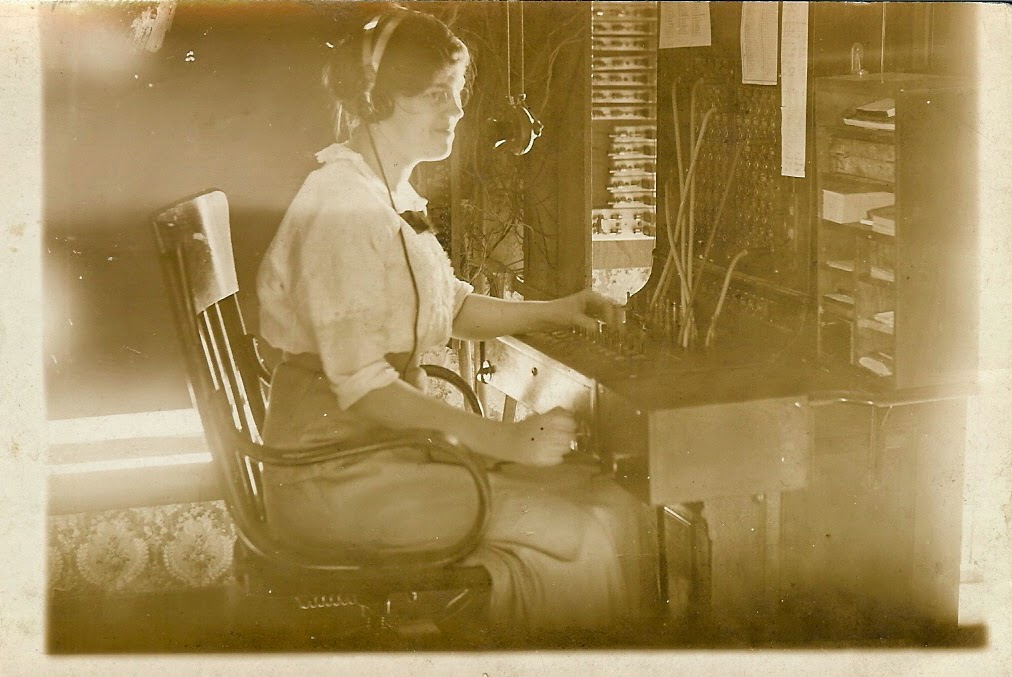
Mammaw completed two years of high school (according to the 1940 census) and reached maturity in Pulaski County. We know from a notation on the back of the next photo that she worked as a telephone operator in Waynesville in 1917:


Lola Elliott - Waynesville, MO - 1917

Two years later Lola was in Springfield, Greene County, Missouri, attending business college. She wrote about that in a letter to my daughter Kim in 1984, adding, "...a girlfriend ask[ed] me to doubledate with a boy just home from the army (WWI) and we went to a show, that was on the 10th of July and the 1st of Oct. we were married... ." That "boy" was my grandfather, Lewis Ames Saunders. They married in Ozark, Christian County, Missouri, on October 1, 1919, when he was weeks short of being 31 years old and Lola was 23. Lewis's sister Evelyn and her husband, John Barkman, were their witnesses.

Photo of Lewis and Lola's original marriage certificate,
which I'm fortunate enough to have in my possession.

Lewis and Lola Saunders - circa 1920

The 1920 U.S. Census shows Lola and Lewis living on Mt. Vernon Street in Springfield and lists Lewis's occupation as stock clerk in the retail furniture industry. Lola was not working outside the home. In November of that year she gave birth to their first child, a son they named Neale. Their second child, Wanda, my mother, was born in Springfield in August of 1923.

Neale and Wanda Saunders - about 1927

By 1930 the Saunders family had moved to a rented house on West Madison Street in Springfield and Lewis was a shipping clerk, still in the furniture business. According to census data collected that year, the family did not yet own a radio set.

A 1932 Springfield, Missouri City Directory shows the family living at 427 Ildereen Drive and Lewis working as a warehouseman at Turner Department Store. (Judy, remember? Ildereen is the street Mother asked us to look for when we visited Springfield in 1996.) Neale was 15 and Wanda was 12 when Lola learned she was pregnant again. The new baby boy, named Joe (after Lola's father) was born in January of 1936. Judging by the house number in the photo below, the family still lived on Ildereen as late as 1937 or '38.


Joe, Wanda and Neale - abt. 1937

By the time of the 1940 U.S. Census they had moved about 15 miles to the small community of Center, Missouri, still in Greene County, where they lived in a rented house and Lewis worked as a sharecropper on a nearby farm. (The community identified as Center in census records seems to have disappeared--or at least to have been renamed. There's another town in Missouri named Center now, but it's nowhere near Springfield.) Those were lean years. The family took in a lodger, a female abstractor named Ruby Reed, to help make ends meet. This is where the family lived when Wanda graduated from nearby Bois D'Arc High School on May 15, 1941.

Wanda's graduation announcement.

The facts get a little fuzzy now because the online city directories for Springfield are missing for the early 1940s. It's possible they didn't even print them during WWII. Anyway, I don't know for sure when the family moved back to Springfield. I do know that Neale enlisted in the Army in November of 1941, and Wanda married my father, Paul, in January of 1942. Paul lived in Springfield, but they eloped and married in Marshfield, about 30 miles away in Webster County. I was born in November of 1942, and Paul shipped out with the army three months later. Sometime in the early 1940s Lewis and Lola bought a two-story, five-bedroom house on East Madison Street in Springfield. That's the house I still think of when I hear the word "home."


City directories were back by 1947, and the one for that year shows that Lewis was working as a warehouseman for Martin Bros. Piano Co. My sister was born in January of 1947 and our parents divorced in July of that year. We moved in with Lewis and Lola, as did Lola's mother, Dora Elliott, who'd been widowed since her husband Joe died in 1933. Young Joe Saunders was still at home, of course. That left one upstairs bedroom available to rent to students attending nearby Southwest Missouri State Teachers College.

When 1957 rolled around, Lewis, Lola, Wanda, Judy and I still lived in that house. Dora had passed away in 1953, and Joe had left home around 1955 or '56 to join the Army. Lewis was retired by then. In the summer of 1957, Mother remarried and moved us to Texas.

I have a copy of a real estate listing showing that Lewis and Lola listed the house on East Madison Street for sale in March of 1960. They sold it about one month later and moved to Texas themselves, where they bought a small, single-story house a few blocks away from us in Orange.

Lewis and Lola Saunders in front of their Orange, Texas home - abt. 1960

Lewis, always known as Packy to us, died in April of 1964 following a series of strokes, but Lola lived in that house for 28 years, longer than anyplace she'd ever lived in her life. In May of 1988 my daughter, granddaughter, and I drove from Louisiana and visited Mammaw in her home. She was as mentally sharp as ever but mentioned that she was losing weight and had begun experiencing some pain in her side. Here's Lola on that visit with my granddaughter, her great-great granddaughter:


Later in 1988, some time after Mammaw had been diagnosed with advanced-stage cancer, she was given hallucination-inducing pain medication, required around-the-clock care that exceeded Mother's capabilities, and eventually entered a nursing facility. She died at the age of 92 on December 4, 1988. She was buried in Orange County--the lowest red star on the map at the beginning of this post. 

*****

I've changed my mind and will add just a couple of paragraphs of personal remembrances from yesterday's Life Writing assignment:

"Lola and Lewis, by then known to me as Mammaw and Packy, made their home ours. I grew up knowing that Packy was considered the head of the household, but it was clear from early on that Mammaw was the one who kept everything going. She was the one who cooked three meals a day, cleaned that five-bedroom house, did the washing on Mondays, the ironing on Tuesdays, shopped for groceries, saw that the bills were paid, tended her flower garden and potted plants, canned home-grown vegetables, made jellies and jams, crocheted and tatted doilies to protect the highly polished surfaces of her furniture, and hummed pleasantly to herself while she did all of it. She went to Sunday school and church every Sunday and took us with her. During the Christmas holiday season, she worked part-time at the Busy Bee Bargain Store to earn extra money.


Lola Saunders, 5th from left


"If she ever met anyone she didn’t like, she certainly didn’t say so. She was friends with all the neighbors and belonged to what she called a club, a group of ladies who took turns hosting lunch once a month in their homes. She was the kindest person I’ve ever known.

"Mammaw was our family’s rock. She was the caretaker of her own confused, elderly mother, the behind-the-ear scrubber of her six-foot-tall teenaged son, the calm after my mother’s temperamental storms, the one who tucked a sick granddaughter into her own downstairs double bed and tended her with hot tea and buttered toast cut into finger-sized strips. In the 1950s, when we teased Mammaw about the lyrics of a popular song, 'Whatever Lola wants, Lola gets,' she said, 'I always do get everything I want, but I always know just how much I can want.'”

*****

Digging up old documents and photos of our ancestors helps us piece together the facts and the journeys of their lives. If you didn't already know--and if you've bothered to read this far--I hope this post has given you some ideas about how to put together your own family puzzles. The truth is, though, that facts like these tell only part of the story. The most important part is what the ancestors you knew personally meant to you and why. Write it down, people, while you still remember. 

Tuesday, March 18, 2014

Scents and Sensibilities

Last week's Life Writing class homework ended up as something entirely different from what I'd started out to write. Here it is, courtesy of a rather pushy muse:

********

On the Internet there are pages and pages of articles about olfactory memory. In one of those articles, “How Smell Works," Sarah Dowdey wrote:  “A smell can bring on a flood of memories, influence people’s moods and even affect their work performance. Because the olfactory bulb is part of the brain’s limbic system, an area so closely associated with memory and feeling it’s sometimes called the “emotional brain,” smell can call up memories and powerful responses almost instantaneously.”

Boy, is that the truth! Except for familiar pieces of music, nothing else takes me back in time faster than smells I recognize from my childhood. I’ve made a list, incomplete and off the top of my head, of scents that embedded themselves deeply in my youthful brain, so let’s try an experiment. Whether you’re listening to my list with your ears or reading it with your eyes, pay close attention to what’s happening with your nose. See if it remembers smells like these:

• Rain, its pleasant scent especially noticeable when there was no thunder or lightning and I was allowed to carry an umbrella and walk at the edge of the street to the end of the block and back, bare feet splashing in the narrow stream of rainwater that flowed against the curb.

• Lilacs and roses, the most fragrant of all the blossoms in my grandmother's carefully tended flower beds.

• Clover, growing wild in the yard or picked by little girls and woven into chains.


• Ripe tomatoes and tall stalks of corn growing in my grandfather's garden, their separate scents as pleasing as the taste of their juices mingled with salt and butter on my plate after supper. I'd stay at the table until everyone else was gone so I could tilt my plate and drink that juice.

• Cinnamon, sprinkled on sugar cookies my grandmother baked mid-afternoon, stacked in her big, porcelain dishpan, covered with a tea towel, kept warm until my sister and I came home from school.

• Crispy, juicy chicken Mammaw fried after church every single Sunday.

• Hamburgers at Taylor's Drive-In, where Mother would take us after a show or a circus. They were made with thin, thin meat patties and dressed with mustard, sliced dill pickles and onions. Their distinctive smell must have been due to the onions, because Taylor's was the only place I'd eat them.

• Baloney sandwiches unwrapped from waxed paper in the school lunchroom; also Fritos, pulled from the same brown paper bag.

• Popcorn in downtown movie theaters--the Landers, the Fox, the Gillioz--to which we rode the city bus on Saturdays to see matinees, black and white newsreels, and colorful Disney cartoons.

• The school smells:  chalk dust, crayons, wood shavings in the pencil sharpener, white paste, oilcloth brought from home to cover desks during art projects, and purple-printed, mimeographed pages to be taken home to our parents. (Of all those items, only the white paste tasted as good as it smelled.)

• Telephone poles. I sniffed them at every inconspicuous opportunity after I discovered that their smell reminded me of the monkey enclosure at the Springfield Zoo. Only later did I learn that that smell was creosote, painted on telephone poles and the wooden posts of the big wire cage as a preservative.

• The healing scent of Band-Aids and adhesive tape and the sinus-clearing smell of Absorbine Jr. rubbed lovingly onto a sprained ankle or Vicks VapoRub spread on my chest under my cotton pajama-top.

• Ivory soap, the big bar that floated in the bath water in the claw-footed tub.

• The cherry-almond fragrance of my grandmother's Jergens hand lotion.

• The lingering smell of shaving cream on my grandfather's cheek when he hugged me soon after a shave.

• The Evening in Paris eau de Toilette I bought for my mother at M. L. Hunter's 5¢ to $1 Store--the smallest, cheapest, deep-blue bottle of Evening in Paris the store sold and the only one that fit my budget.

• The fresh smell of laundry starch being cooked on the stove to be carried in its pot gingerly, with pot-holders, down the basement stairs and poured into the tub of the old wringer washing machine.

• Sheets and pillowcases that had hung all day on the backyard clothesline to dry in the sun and wind.

********

Some things stink; it's a fact. Not all the smells that stir memories are pleasant ones, even if the memories themselves are nice. Here are some not-so-nice smells that have stayed in my brain in a good way:

• The dank mustiness of the basement when my sister and I played down there to beat the summer's heat.

• The chlorinated water of the swimming pool at Fassnight Park and that same strong chemical odor, diluted by a mere hint of urine, in the bathhouse next to the pool. Those smells meant cool water on a hot day; it was easy to tolerate them.

• My own perspiration on my fingertips after I'd sat outside on the front-porch swing in summer, arms crossed over my chest, hands tucked into my armpits. There was a time when I thought my sweat smelled like corn silks, but that changed well before junior high.

• Dirt kicked up by children's feet on dusty playgrounds. Along with bruised arms, dust in our nostrils was the price we paid for Red Rover, Red Rover.

• Lightning bugs. Their odor wasn't noticeable unless a bunch of them were collected in a jar or a lighted tail was crushed and spread around the base of a finger to make a glow-in-the-dark ring.

• Sneakers and socks, wrapped in gym clothes brought home for laundering after five days crammed in a school locker.

• Rotten eggs, previously hard-boiled, dyed, and surrounded by jellybeans and chocolate-marshmallow goodies in an Easter basket, then hidden by me for more than a week behind a rack of winter coats and a big trunk on the floor of the closet underneath the stairs. My Uncle Joe never found my basket, but I had to throw out more than he would have stolen.

********

Good or bad, smells are powerfully evocative. My sister and I once traveled together to a family reunion in Springfield, Missouri. That was in 1996, nearly forty years after we'd moved from there to Texas. About thirty miles before we reached our destination, Judy opened the sunroof and a forgotten but familiar fragrance wafted into the car and hit us right in our hearts. The scent was so compelling that nostalgic tears began rolling down both our faces. We never did find out what unidentified substance our olfactory bulbs had picked out of the Southwest Missouri air; none of our relatives who lived there noticed any unusual or distinctive scent at all. Whatever it was, it smelled exactly like home.

______________________________

One purpose of the Life Writing class exercises is to remind us of stories we might not otherwise think to write. After finishing the homework piece above, I realized that there's at least one story to be written about every item on that list of remembered smells. I may write them--using the list as a meme for blog posts--when the current class sessions end.

Now it's your turn:  What smells from your own childhood have stayed with you?

Tuesday, March 11, 2014

La Buena Vida - 1970-1971

The assignment for the Life Writing class I'm taking was to make a timeline of important events in our lives, then write about one of those events. Here's my story (with added links and photos) about our move to Miami, Florida:

********

In the summer of 1969 my husband, Richard, two daughters, eight-year-old Kim and six-year-old Kelli, and I moved back to our home in Orange, Texas after a six-month stay in Mentor-on-the-Lake, Ohio. As happy as we were to be home, it didn’t take long for us to realize at least one advantage of living away from there. Richard was my second husband. Our friends and families in Texas couldn’t resist giving us regular updates on the activities of my ex-husband or his ex-wife, reminders that plunged us momentarily into our separate, not-so-pleasant pasts. In Ohio it hadn’t been like that; new friends and neighbors there treated us like the bonded family unit we’d become since our marriage a year earlier.

That’s one reason why we didn’t hesitate to move again the next summer, 1970, when the number of East Texas construction jobs trickled down and Richard’s union spread the word that  the Turkey Point nuclear facility in Homestead, Florida, near Miami, was offering premium pay for highly skilled, certified welders. We put our house up for sale, sold it quickly, then waited around for both the closing date and my ten-year class reunion. Over the next few days we put our best furniture in storage, gave away the rest of it, then loaded up the station wagon and a small trailer, said our sad goodbyes, and took off early one morning for the bright lights and big city.

Our first bit of bad luck occurred about four hours into our trip when the station wagon broke down as we passed through a seamy-looking, industrial section of New Orleans. Richard managed to get the engine going again long enough to coax it to an auto-repair shop, where he parked and unhooked the trailer at the side of the lot. The family parked in the non-air-conditioned shop office, spending an entire afternoon and a hefty chunk of our savings there.

Upon our eventual arrival in Miami, we checked into a motel and settled in to stay for a few days. The next morning, after a Waffle House breakfast, Richard left to locate the nuclear plant, where he was tested for the better part of the day and hired to begin work the following day. Meanwhile, we began searching the newspaper for a furnished house in a good school district. The cantaloupe-colored, stucco-sided, two-bedroom house we found and rented was owned by a Cuban lady, Mrs. Phelps, who had recently moved to New Jersey, leaving behind cupboards full of dishes and an attic full of Christmas lights and decorations. The house was on a corner in a neighborhood of similar stucco, pastel-colored houses, the elementary school within easy walking distance. A fruit-laden mango tree grew in one corner of the backyard near a cluster of other small trees on which Mrs. Phelps had cultivated beautiful orchids.

Kelli and Kim in backyard of Miami house.

On our first full day in the house Richard went to work, I got busy putting the house in order, and the girls went outside to play. Moments later I heard a scream and looked out to see Kelli flat on the ground. She had tried to climb a tree in the front yard and had fallen from its branches. She was unconscious for a brief moment, her thoughts noticeably confused after she came around. I was panicking inside but tried to remain calm. We had sold our second car before the trip; I had no way to drive Kelli to an emergency room, even if I’d known where to find one. Our telephone wasn’t due to be installed for another day or two, so I couldn’t call for help, and we hadn’t yet met a single neighbor. All I knew to do was pray silently, put an ice bag on the bump on her head, and watch her constantly to keep her from falling asleep. As I remember it, she recovered long before I did.

On Richard’s first day off work we couldn’t wait to explore the tropical paradise we’d call home for the immediate future. We put our bathing suits on under our clothes, jumped into the station wagon, and drove over the bridge across Biscayne Bay to spend the day on glamorous Miami Beach. We were disappointed to discover that most of the beachfront property was inhabited by high-rise hotels and restricted to their guests. Finally, after driving around for a while, we spotted a stretch of beach that was accessible to us. Amazingly, it wasn’t even crowded. We undressed in the car, picked up our blanket, towels and picnic lunch, walked across an asphalt parking lot into the sand, and got our first clear view of the Atlantic Ocean. We were filled with excitement as we dropped our bundle and raced knee-deep into the gently lapping waves. The girls squatted down to immerse their bodies in saltwater up to their necks, and Kim stood up again almost immediately, saying, “Look! I found a balloon.” Kelli popped up right behind her: “I found one, too!” Each of them was holding up a used condom. Richard and I gaped at each other for a split second before he ordered, “Drop it and get out of the water; we’re going home.” Our first dip in the Atlantic Ocean had been in a stream of raw sewage from a nearby posh hotel. I don’t remember how we explained our sudden departure to the girls.

Things got better after that. The girls made friends in the neighborhood and more friends once school started. I was Kelli’s first-grade room mother and did my share of walking the same path they walked to school, usually with cookies or cupcakes in hand.

We quickly established favorite places to go in Miami: the Steak & Brew restaurant for Saturday night family dinners that included unlimited pitchers of root beer; the rock quarry where the girls could swim in clean, crystal-clear, fresh water; and, best of all, the grassy inlet where we could wade out and surf fish in saltwater. We baited our hooks with long strips of mullet and caught two-foot-long, hard-fighting barracuda, one right after another. Richard cleaned them on the spot, storing thick fillets in an ice chest to fry when we got home. We left those fishing trips feeling tired but happy. Richard drove while I rode shotgun with my bare feet on the dashboard and sang along with the radio about "me and you and a dog named Boo.” In the backseat the girls munched on fresh peaches, the dripping juices leaving trails in the dirt on their arms. We fished that same spot many weekends, abandoning it only after staying there till nearly dark one evening when Kelli got her line tangled on her last cast and Richard slowly inched it back in to find a five-foot shark on the end of it.

Kelli and Kim in crystal-clear waters of rock quarry.

We visited the popular tourist attractions, too, mostly when friends from Texas came to see us. Unenlightened in those days about the plight of dolphins, we thoroughly enjoyed their leaps, spirals and splashes at Miami Seaquarium. We visited the Serpentarium, fronted by the towering head of a giant, concrete cobra, and made numerous trips to Parrot Jungle & Gardens, a mecca of tropical plants and brilliantly colored birds where we took turns being photographed with parrots on our heads and outstretched arms. We went several times to the real tropical beach, the kind we’d expected in the first place, at Crandon Park on Key Biscayne. We’d alternate playing in the ocean and resting in the sand, frequently treated to Calypso rhythms on drums and guitars played by dreadlocked musicians set up under a tarp a little way down the beach. We also enjoyed watching the ever-present Limbo dancers: young, suntanned men and women who threw their heads back and laughed as they competed to answer the challenge: “How low can you go?”


Top to bottom: Kelli, Kim and Linda at Parrot Jungle


Kelli and Kim on the beach at Crandon Park

One day we traveled north of Miami into the Everglades National Park to show Kim and Kelli the wilderness, a place untouched by time (if you don’t count the wooden boardwalks with railings to keep fools and children from falling into the swamp). We took off once for a weekend mini-vacation in Key West, driving seemingly endless miles across narrow roads and bridges to see sea turtles and spectacular sunsets. Another day we woke the girls up before daylight and drove to Cape Canaveral (called Cape Kennedy then) to see the launch of Apollo 15. A lot of other people must have had the same idea, because what I remember most about that event was a vast sea of parked cars that stretched interminably around us. We waited and waited, in and out of the car, and finally saw in the distance a big puff of smoke that obscured the rocket-ship headed for the moon. 

At some point we did get a second car. Having the station wagon always available made my life easier, and the little blue Corvette (used) that Richard had fallen in love with was perfect for him to drive to work and for the rare nights we went out dancing. Those were the days when hot pants were in fashion, so I’d put on mine, either with go-go boots or Roman sandals with long straps that wrapped around my calves and tied behind my knees, and Richard would wear his striped, flare-legged pants and a gauzy shirt that had puffy pirate-sleeves and a big, pointed collar, leaving the shirt unbuttoned halfway down his chest. He’d pick up the kids’ favorite baby sitter, then we’d head out in the Corvette for a night on the town. Miami was known for its nightlife, but it was expensive. Most of the nicer clubs had a three-drink minimum, and we limited ourselves to that. Fortunately, I never acquired a taste for liquor, so we’d both order bourbon with Coca-Cola on the side. I’d drink all the Coke, and Richard would drink the bourbon.

Linda, Kelli & Kim with Richard's blue Corvette.

Linda, posing with Flamenco dancer at Miami Beach nightclub. 

There were plenty of ordinary days in Miami, too. Richard worked from four to midnight, so I slept in shifts. I’d stay up until he got home around one in the morning, fix him something to eat while he unwound and we shared the news of the day, then we’d go to bed. I’d sleep for a few hours, get up to get the girls off to school, then go back to sleep another hour or two. After a while it began to feel normal. We had a house to clean, grocery shopping to do, dentist appointments to keep, all the things people need to do wherever they live. Somehow, though, surrounded as I was by dense greenery, vivid flowers and bright sunlight, I didn’t mind those chores and errands as much as usual.

In Miami I felt alive, almost electric, with a grand sense of freedom and adventure. We lived there for just over 18 months. When the nuclear expansion became operative and Richard’s job ended, we moved on to new places and new adventures, but I don’t think we were ever again as carefree as we’d been during our Florida days.

I’ve been told that Miami has changed in the forty-plus years since we were there, that it’s a harder, harsher place to raise a family now, not as safe as it once was. I guess that’s true of most places.